Insomnia is the most common sleeping difficulty and affects people of all ages. Features include difficulty getting off to sleep and trouble staying asleep, worrying about sleep, and tiredness during the day.
There are many different reasons for insomnia. A pattern of poor sleep may start during a period of stress or other sleep disruption (e.g. from shift work, jet lag, crying infant, snoring bed partner). It can then become chronic even after the initial cause is no longer present. The poor sleep pattern is maintained by a conditioning (habit forming) process that produces alertness while trying to fall asleep or back to sleep.
Other possible contributors to a poor sleep pattern include:
Excessive consumption of caffeine or alcohol in the evening
Excessive time spent in bed
A mistimed body clock (e.g. regularly falling asleep and awakening either too late or too early)
Inappropriate ideas or beliefs about the nature of sleep and consequences of sleep loss
It is important to diagnose the specific pattern and causes of the insomnia in order to prescribe the most appropriate treatment. The AISH Insomnia Treatment Program does not prescribe sleeping pills because they can lead to drug dependence and daytime impairment. Although they may provide symptomatic relief for short-term insomnia, these medications do not treat the causes of insomnia. Non-drug therapies can treat the causes of insomnia and provide more effective long term treatment of chronic insomnia.
These non-drug therapies include:
Promoting daytime behaviours conducive to better sleep
Stimulus control therapy
Bed period restriction therapy
Bright light therapy
Relaxation therapy
Cognitive therapy
The Insomnia Treatment team, led by Professor Leon Lack and colleagues, has pioneered the scientific research and technological developments for some of these therapies. This treatment program is unique in making available some practical treatments emerging from this scientific research. In addition, Professor Lack has more than 20 years experience with the non-drug treatments of insomnia.
The treatment program consists of:
A diagnostic home night time sleep study to evaluate the biological sleep pattern
A diagnostic consultation (50-60 minutes)
A group education session (8-10 per group) of two hours.
A personalised treatment commencement session (30 minutes)
A one week follow-up consultation (30 minutes)
Three weekly telephone / email contacts (5-10 minutes each)
A five week follow-up consultation (30 minutes)
A three month follow-up consultation (30 minutes)
The program fee is $575 (concessions apply; private medical insurance rebates may apply
Appointments will be made upon booking the program. Medicare rebates apply upon referral with a Mental Health Care Plan from a GP. A single Medicare gap of $49.35 applies.
More---http://www.adelaidesleephealth.org.au/facilities_and_services/insomnia_clinic
This page presents an overview of the use of light therapy for treating a range of disorders such as insomnia, winter depression, and jet lag arising from mis-timing of the 'Body Clock'.
If you are only interested in the availablility of the LED light glasses please email Re-Timer TW.
Visual light stimulation for re-setting the body clock
The Body Clock times the 'ups and downs' of our biology and behaviour across the 24 hour day. It determines when we feel sleepy and when we are alert. When body temperature and metabolic rate are 'up' or at their highest, for most people at about 6-8 pm in the early evening, then muscular strength, speed of reactions and alertness are at their highest for the whole day. Likewise, most people have their 'down' or lowest levels of body temperature, metabolism, speed, and strength at around 4-5 am in the morning. This time is also when we are sleepiest and most likely to fall asleep quickly. This high sleepiness tendency in the early morning can probably account for the high death rate in single vehicle accidents and other notable accidents due to 'human error', in these cases a result of falling asleep in dangerous situations.
Night shift work
The strength of our body clock on our sleepiness/alertness tendency can also be demonstrated in night shift work when it is very difficult to remain awake during the hours of 3-6 am. In addition the night shift worker finds it difficult to sleep during the day because the body clock is programmed for wakefulness in the day time.
Jet lag
If we fly overseas across many time zones, we can experience difficulty staying awake during the day and sleeping soundly at night. Why does this happen after crossing time zones? The jet traveller’s body clock remains set for Australian time which may be up to 12 hours different to their destination. The body clock would still be saying it is time to sleep during what is Australia’s night time. The result is an overwhelming desire to sleep during the daytime of the overseas destination. And across the night time of the overseas destination the body clock would be saying it is time to be awake. This results in broken and unrefreshing night time sleep. These effects of this body clock mis-timing we call 'jet lag'. It may take several days or weeks to get over the jet lag. 'Getting over it' is the process of re-timing our body clock to link in with the new destination day/night time.
Insomnia
There are common types of insomnia which also are caused by mis-timing of the body clock. Sleep onset insomnia is the chronic difficulty in getting to sleep at the desired time, but sleeping well once asleep and then having difficulty arising in the morning in time for daytime responsibilities. These people have body clocks timed too late or are delayed compared to normal sleepers. The delayed body clock means that the alert period of the body clock may be timed as late as 10 pm to 1 am and will make it difficult to get to sleep before 1 am. If it is then necessary to awake at 7 am then there will be insufficient time to get a full night’s sleep resulting in daytime tiredness.
Another type of insomnia, more common in older people, is early morning awakening insomnia. These people fall asleep easily early in the night but then awaken early in the morning without sufficient total sleep. Their body clocks are timed too early signalling that it is time for daytime wakefulness before they have had sufficient sleep.
Winter depression
Probably the greatest use of bright light therapy is for the treatment of winter depression, especially in very northern countries which have little sunlight in the winter months. These sufferers appear to have delayed body clocks and benefit most from morning light therapy.
Bright light therapy
Research shows that bright light visual stimulation (light which enters the eyes), can change the timing of the body clock and its timing of sleep or awakening signals to the body. Thus, bright light therapy has been used to treat the range of disorders caused by a mis-timed body clock including shift work, jet lag, sleep onset and early morning insomnia mentioned above as well as winter depression (Seasonal Affective Disorder, SAD).
In the case of night shift work, bright light stimulation in the early morning (12 midnight to 4 am) can delay the body clock up to 6 hours moving the sleepy period from early morning to the middle of the day. Workers are then alert on the night shift and can sleep well during the day.
People eventually overcome jet lag effects but may take weeks to do so. You can get over jet lag more quickly by getting daytime exposure to bright light (getting outside into the sunlight). This re-times the body clock to enable daytime alertness and good sleep at night time. In the case of flying westward, as from Australia to Europe, to get over the jet lag in Europe your body clock needs to be delayed. This is what was needed in the night shift worker and accomplished by light during the early morning hours in Australia. However, in Europe these same hours with respect to your body clock will be late afternoon. Therefore, getting light stimulation from the early afternoon for as long as sunlight is available will help you get over jet lag more quickly. If it is summertime in Europe with sunshine until late, then getting outdoors for the rest of the day from 3 pm onwards will be very helpful. However, if you need to stay indoors or if it is the cold and dark weather of winter, then the assistance of the LED light glasses can produce a similar beneficial effects to that of sunlight.
For sleep onset insomniacs who have delayed body clocks we have shown that treatment with bright light stimulation in the morning (7-9 am) is helpful. For early morning awakening insomnia in which the body clock is timed too early, we have shown that evening bright light stimulation is beneficial. It delays their rhythms, delays their final awakening, and increases their total amount of sleep.
Bright light therapy at present
The present most common mode of delivering bright light is with the use of manufactured light boxes. These devices have the important market advantage in having been extensively used in circadian rhythm research with proven ability to affect the timing of circadian rhythms. However, these devices have four handicaps.
1.They have to be large (60cm X 50cm X 20cm) in order to contain sufficient high intensity fluorescent tubes to provide 3,000 - 10,000 lux illumination when placed approximately a metre from the user.
2.They are not readily transportable because of their weight and need for mains power.
3.The high intensity and somewhat aversive light source is fixed in space and can be easily avoided with change of direction of gaze. Compliance to directions of use may be poor and inadequate for therapeutic effect.
4.They are expensive to purchase (US$300 - US$500).
Flinders LED light glasses project
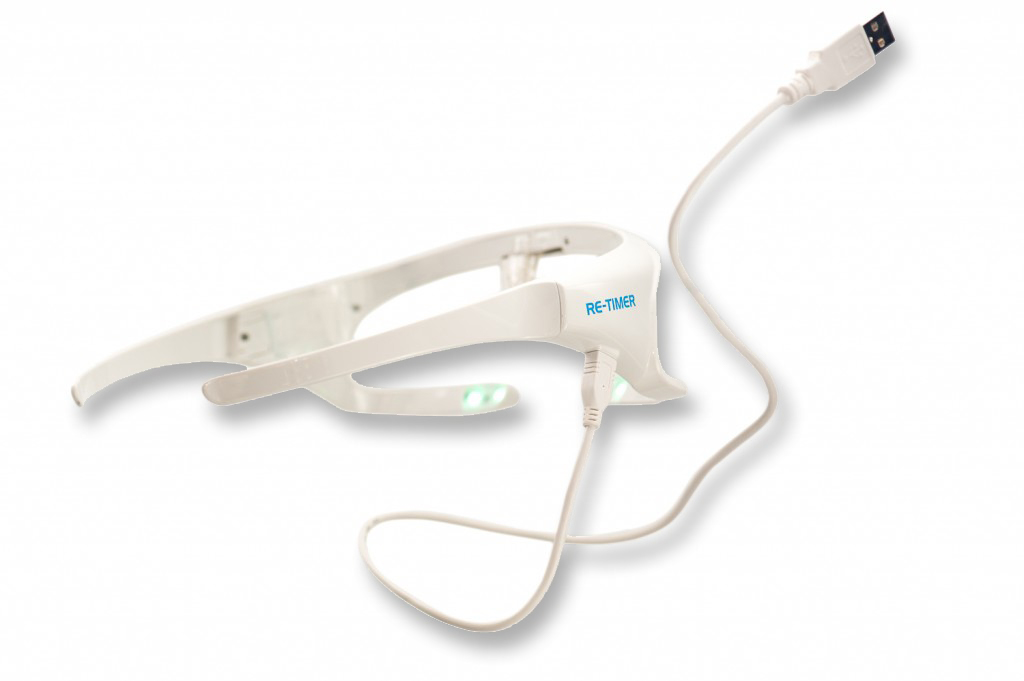
We have fully evaluated devices with light emitting diodes (LEDs) mounted on spectacle glasses for their body clock re-setting capacity. The glasses mounted LEDs provide light stimulation of equivalent intensity to light boxes for 20 hours operation on one small, inexpensive 9 volt battery. They are easily portable and can provide the possible therapeutic effects while the user is mobile or in situations where domestic power is unavailable such as a passenger in a moving vehicle or jet plane.. Because of their small size and relatively inexpensive components, the LED glasses will be less expensive than the presently marketed light boxes. They suffer none of the handicaps of light boxes listed above. One of their main advantages is that our research has confirmed their body clock re-setting effects which are the basis of treatment for all of the above conditions.
Using coloured LEDs as light sources also made it easy to test different colours for their capacity to re-time the body clock. This has been the focus of our research over the past three years. To summarise, the blue end of the visible spectrum contains the wavelengths of benefit for body clock re-timing. The scientific results show some effect starting about 530nm (green) and increasing in effect with shorter wavelengths reaching a maximum at about 450-510 nm (blue and blue/green). Our LED light glasses use this most effective colour range for re-timing the body clock.
At present the LED glasses are still experimental devices. They are not yet commercially available. Flinders Partners is heading this commercialisaton project. Their information can be found here.
Book for non-drug insomnia treatment
A useful small book for the understanding of sleep and management of insomnia by Dr Helen Wright and Professor Leon Lack can be ordered on-line.
More---http://www.flinders.edu.au/sabs/psychology/research/labs/sleep/bas.cfm
The brain circuit for light reception, input to the circadian clock, and the production of melatonin.
The Center offers a specialized program in chronotherapeutics – a novel set of biological rhythm correction procedures designed to:
establish normal sleep onset time for people who cannot fall asleep until it is too late, or have trouble waking up because of fragmented sleep;
relieve winter depression (seasonal affective disorder, or SAD, or the milder winter doldrums or winter blues);
alleviate symptoms of unipolar and bipolar depression, whether or not the depression is seasonal;
increase daytime alertness and reduce slumping in the afternoon and evening;
substitute light therapy for drugs during pregnancy;
improve cognitive performance, mood and sleep in adult attention deficit hyperactivity disorder;
work effectively when drugs have not worked, worked only partially, or cannot be tolerated; and
work effectively in conjunction with antidepressants and mood stabilizers.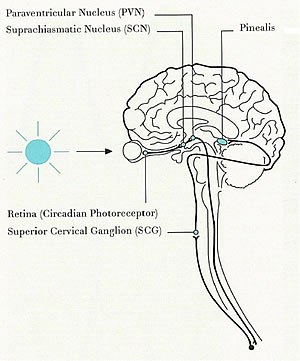
What is chronotherapeutics?
A person's internal biological rhythms are vulnerable to drifting away from local day and night, causing problems with mood, energy, and sleep. Columbia clinical researchers have been international leaders in creating a set of methods – mostly drug-free and based on timed light exposure – to resynchronize the internal clock. In many cases this has resulted in major clinical improvement and even remission of symptoms. Sleep and mood are intimately connected, and sleeping out of sync with one’s clock may be responsible for mood and energy problems: the shifted sleep is not just a symptom of depression.
The Center for Light Treatment and Biological Rhythms is a unique clinical program in the United States, with its coordinated focus on circadian rhythm, mood and sleep disturbances.
Outpatient services begin with an extended diagnostic evaluation session in which an individualized treatment regimen is generated to follow at home. Over six weeks, we actively monitor progress and, if necessary, hone the treatment regimen to achieve maximal response.
Hear about Dr. Terman’s research on National Public Radio.
Many of our patients are referred by their primary mental health provider. In those cases, we work as a team to coordinate treatment. We work with outpatients across the country and abroad as long as they can visit New York for the evaluation workup. The Center also offers services to inpatients at Columbia University Medical Center.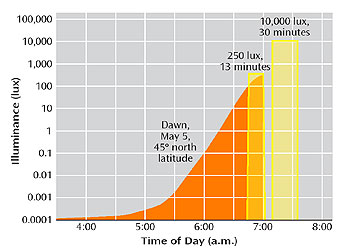 Treatment Approaches
Terman M, Terman JS. Controlled trial of dawn simulation and negative air ionization for seasonal affective disorder. American Journal of Psychiatry 2006;163:2126-33
Bright light therapy. Our group developed the state-of-the-art treatment regimen that has become the international standard. We employ apparatus that has been tested for efficacy, safety. and minimal rate of side effects, with endorsement by ophthalmologists. Our specialized expertise includes light dose titration, in some cases with the possibility of reduced reliance on medication.
Dawn-dusk simulation. A dimmer, dynamic light signal is automatically presented in the bedroom as the patient goes to sleep, before wake-up, or both, depending on the circadian rhythm phase and sleep pattern. The intervention is the fruition of our group's longstanding translational research program on twilight effects on circadian rhythms.
Recommended reading for discussion with your doctor: Dr. Terman’s future-look at light therapy (PDF download), and the Columbia group’s guide for the clinical practice of light therapy
Melatonin
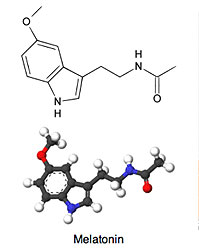
The pineal gland in the brain secretes the melatonin hormone under control of the internal clock, usually at night. Our group has taken a major step forward in developing a chronotherapeutic formulation of physiological-dose, controlled-release melatonin that can serve synergistically with light (but at opposite times of day) to resynchronize the circadian clock. The tablet can also be used to amplify the endogenous blood level in patients whose sleep may be compromised by low pineal melatonin secretion. Past formulations are vulnerable to rapid washout, controlled-release morning overshoot, and spiking in blood far above the physiological range.
More---http://columbiapsychiatry.org/clinicalservices/light-treatment-center
Bright Light Therapy is used to manage circadian rhythm disorders such as delayed sleep phase syndrome (DSPS), a condition which shifts the normal sleeping pattern outside what is considered the social norm. People who have DSPS generally don’t fall asleep until several hours after Midnight and have trouble waking up in the morning, making adhering to a normal work or school schedule difficult. However, if allowed to follow their own schedules, their quality of sleep is otherwise normal.
Bright Light Therapy is used to gradually shift sleeping patterns to what we consider normal. For treatment, the timing of light exposure is critical. For DSPS, the light must be delivered to the retina as soon after spontaneous awakening as possible to achieve the desired effect. People have also reported success with lights that turn on shortly before awakening, to simulate dawn. Morning use may also be effective for non-24-hour sleep-wake syndrome, while evening use is recommended for advanced sleep phase syndrome.
Light therapy – also called phototherapy – uses a full-spectrum lamp or portable visor, usually 10,000 lux in intensity, for 30–90 minutes at the patient's usual time of spontaneous awakening, or shortly before. Treatment sometimes uses sunlight. Experimentation with a specialist help will show how much the treatment can comfortably advance.
For maintenance, some patients continue the treatment indefinitely, while some reduce their daily treatment to 15 minutes. Others may use the lamp a few days a week or even every other or third week. The degree of success is different for each patient. Light therapy generally adds a little extra time to the morning routine. If you have a family history of macular degeneration, you should consult with an eye doctor prior to starting Bright Light Therapy.
More---http://stanfordhospital.org/clinicsmedServices/clinics/sleep/treatment_options/bright-light-therapy.html

睡眠不足(失眠)可不是鬧著玩的。失眠會導致反應力下降、記憶力減退、甚至健康疾病。所以,如果你長時間都在一個環繞地球的價值1500億美元的航天飛船上,你就會知道睡眠的重要性了。對於現在社會普遍的流行性失眠症,美國宇航局(NASA)準備使用特殊發光裝置對國際空間站(ISS)進行一次改造,以解決航天員的失眠問題。